When Family Photos Stop Being Proof We Were There
Some of my earliest memories of photography are tied to a smell.
My grandfather developed photographs on the kitchen table of his home in Santa Cruz, California. Long before I understood exposure, film chemistry, or the mechanics of a darkroom, I knew the sharp chemical scent of developer and fixer. It drifted through the house and attached itself to those damp black-and-white prints as they became part of our family history.
Years later, when I began studying photography, I walked into a darkroom and the smell brought everything back at once. I was no longer standing in a college workspace surrounded by enlargers, trays, and other students. For a moment, I was back in my grandfather’s kitchen, watching photographs emerge and listening as family members told the stories attached to them.
Even now, some of those old prints retain a trace of fixer beneath the more familiar smell of aging paper. They have faded, softened, and picked up the small scars that objects acquire when they survive several decades of handling. Their physical condition has changed, but the moments inside them remain remarkably direct.
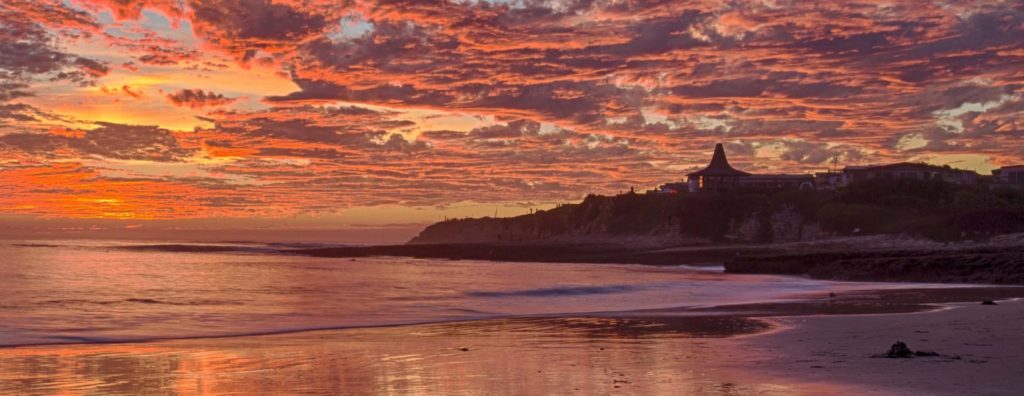
My grandfather photographed backyard gatherings, relatives standing beside cars, informal celebrations, and the ordinary events that gradually become extraordinary once enough years have passed. He was also a beach photographer, and his black-and-white work from Natural Bridges State Beach shaped the way I would eventually approach landscape photography.
Those images did more than show me a place. They taught me how someone I loved had looked at it.
Many years later, I took some of his photographs back to the locations where they were made. I stood in the same places along the street and returned to the same areas near the beach, then created a then-and-now series that placed his Santa Cruz beside mine. I scanned and restored the original prints, removing decades of dust, fading, and damage while preserving the photographs themselves.
The experience felt less like repairing old pictures and more like extending a conversation.
He had stood there with a camera, and decades later, I stood there too.
That certainty mattered. The photographs may not have told the entire story, and the family members explaining them were not always reliable narrators. Family history has a way of improving with age. Storms become more violent, fish grow longer, and relatives who were merely stubborn become legendary forces of nature. The exaggerations were often part of the charm.
Yet beneath the shifting details, there was an anchor. Someone had been there. Light had reflected from a person, a backyard, or a beach and traveled through a lens onto film. Whatever version of the story survived around the photograph, the moment itself had existed.
That basic relationship between photography and reality has shaped family memory for generations.
Artificial intelligence is beginning to change it.
The Six-Finger Era
The earliest wave of widely shared AI-generated images often announced its own artificiality.
A face might look convincing until the viewer reached the hands, where fingers multiplied with the confidence of a magician who had forgotten how many were supposed to be there. Teeth melted together. Earrings disagreed with one another. Background figures lost limbs or acquired extras. Signs contained lettering from an alphabet invented moments before the image was rendered.
Those images could be impressive, strange, funny, and occasionally unsettling, but they were usually identifiable. We learned to count fingers and inspect reflections. The errors became part of the cultural language surrounding AI images.
The six-finger era will probably look quaint sooner than we expect.
Image-generation systems have improved at a staggering pace. Problems that seemed fundamental a few years ago are gradually becoming technical footnotes. Hands are more convincing. Text is more reliable. Clothing folds more naturally. Lighting behaves with greater consistency. Generated people increasingly resemble photographs of people rather than approximations assembled from the statistical memory of millions of images.
There are still clues, and there are still mistakes, but the direction is clear. The obvious fantasy is becoming plausible.
A photograph of me standing on the moon would not create much confusion for my future descendants. They may question some of my life choices, but they are unlikely to believe I quietly joined a lunar mission and neglected to mention it.
The problem is not the moon.
The problem is the beach.
A generated photograph of me standing beside the pyramids could be entirely convincing. I could be shown wearing clothes I own, standing beneath the Egyptian sun with the plateau stretching behind me. The lighting could match the location. Dust could cling to my shoes. Other tourists could appear in the background. Nothing in the frame would need to look impossible.
I have never visited the pyramids.
Several decades from now, someone opening an old family archive may not know that.
More troublingly, they may open a genuine photograph of me standing on a beach and wonder whether that happened either.
Photographs Have Never Been Untouched
It would be easy to look at this change and retreat into a comforting story about an earlier era when photographs were pure, objective records of reality.
That era never existed.
The moment a photographer raises a camera, choices begin shaping the truth. We choose where to stand, which lens to use, what belongs inside the frame, and what should remain just beyond it. We choose the moment of exposure, preserving one fraction of a second while allowing every moment before and after it to disappear.
Film changed the colors it recorded. Different papers changed contrast and tone. Darkroom printers dodged, burned, cropped, softened, sharpened, combined negatives, and replaced skies long before anyone had heard the word Photoshop.
My grandfather had his own approach to finishing a print. Certain choices made his work identifiable as his, just as the way I process my photographs has become part of my visual signature. When I take a RAW file into Photoshop, I adjust color balance, shadows, highlights, contrast, and a series of finishing elements I have developed over years of working with images.
There is no such thing as an untouched photograph.
A RAW file is not a finished image. It is information waiting to be interpreted. Turning it into a photograph someone can print, publish, or share requires decisions.
This is why the divide between real and false cannot simply be drawn between images that have been edited and images that have not.
Removing a distracting person from a travel photograph does not necessarily erase the truth of the trip. Replacing a dull sky may create a more beautiful interpretation of a landscape the photographer actually visited. Adjusting a portrait subject’s skin or removing a temporary blemish changes the image, but it does not automatically invent the person.
Photography has always balanced documentation with interpretation.
The deeper distinction may be between changing the appearance of a moment and creating a moment that never occurred.
Even that line is not perfectly clean.
If I photograph a real location and replace the sky, I have combined two realities into an image that did not exist exactly as shown. If I remove a stranger from the background, I have altered the historical record of who occupied that space. If someone uses AI to make themselves thinner in a birthday photograph, the event happened, but the person did not look exactly as the image claims.
At what point does an improved memory become a manufactured one?
Photography has never given us an easy answer, but generative AI has made the question much harder to ignore.
The Difference Between Fantasy and Memory
When I first learned Photoshop, one of the obvious things to do was place my children on the moon.
I suspect a generation of new Photoshop users did something similar. Once someone learned to cut a person away from a background, the next logical step was to put them somewhere they could not possibly be. The moon, outer space, the deck of a pirate ship, or the back of a dinosaur were all fair game.
Nobody mistook those images for documentary photography.
The fiction was the point.
AI-generated fantasy images belong to the same tradition. A child riding a dragon, a family posing on Mars, or a black Labrador commanding a pirate vessel can be playful and creative. These images do not threaten family history because they do not pretend to be ordinary memories.
Plausibility changes everything.
Imagine an AI-generated photograph of a family standing together at a beach. The people are dressed casually. A child holds a plastic bucket. Waves break in the distance while the sun sinks toward the horizon. The scene contains nothing impossible and nothing dramatic enough to invite suspicion.
Did that family take the trip?
Were those people together?
Was the child ever that age at that beach?
The image might have been created because the family never managed to take a good photograph during the vacation. Perhaps one person was always missing because they held the camera. Maybe the weather was terrible, the children were miserable, or the beach was crowded. An AI tool could create the image everyone wished they had made.
That image could become the version of the vacation that survives.
The real snapshots might remain buried in a phone backup, poorly exposed and badly composed, while the perfect synthetic memory becomes the one printed, shared, and remembered.
The event happened, but the photograph did not.
In another case, the vacation may never have occurred at all.
The two images could look identical.
The Archive in the Closet
My grandfather’s photographs existed as physical objects. A print could be held, passed around, and turned over. He was careful about writing names, locations, and dates on the backs. The ink became part of the object, physically connecting the image to the information that gave it meaning.
Those notes did not guarantee perfect accuracy, but they traveled with the photograph.
Our family archives now live in very different places.
They are stored on phones, hard drives, cloud accounts, optical discs, social media platforms, and network-attached storage systems. My own long-term files live across multiple devices and backups, following the familiar practice of keeping three copies on two different formats, with one stored away from the others in case of fire, flood, or another disaster.
The system protects the files.
It cannot guarantee that someone will understand them.
Decades from now, one of my children or grandchildren may find an old NAS sitting on a shelf or packed inside a box of obsolete electronics. Assuming the drives still function and someone can recover the data, the device may contain hundreds of thousands of images.
There will be family photographs, travel pictures, finished artwork, RAW files, restored images, alternate edits, scans, composites, screenshots, experiments, and duplicates. There may also be AI-generated images mixed into the same collection.
A folder name may offer little help. Photographers are not always known for elegant archival naming. Entire creative histories have been entrusted to folders called FINAL, FINAL-NEW, FINAL-REALLY, and USE-THIS-ONE.
Even without AI, the volume creates a problem.
My grandfather’s prints could be spread across a table and explored. A modern archive may contain more photographs from a single weekend than an earlier family created in several years. The important images can disappear beneath thousands of nearly identical frames, casual screenshots, accidental photographs of the floor, and fourteen versions of the same sunset.
Future generations may inherit more visual information about us than any previous generation and still understand less.
They will need to decide which images mattered, what the images depict, and whether the depicted events occurred.
A forgotten NAS may become a family album without an editor, a storyteller, or a reliable distinction between evidence and invention.
Can Technology Preserve Trust?
There are already efforts to record how digital images are created and modified. Provenance systems can attach information about the camera, software, edits, and generative tools involved in making an image. In theory, a future viewer could inspect that history and understand whether an image began with a camera capture or a text prompt.
The idea is useful.
I am less certain about its longevity.
Metadata can be stripped. Files are copied, exported, compressed, uploaded, downloaded, reformatted, and moved between systems. Labels can be changed. Platforms disappear. Companies fail. Standards evolve. Software required to read a credential may be unavailable when a future family member eventually opens the archive.
A handwritten note on the back of a print may survive because it needs no compatible operating system.
A sophisticated digital authentication system may preserve far more information, but only as long as someone can still interpret it.
Three perfectly preserved copies of an ambiguous image remain three perfectly preserved copies of an ambiguous image.
Education may help, but it presents its own problem. The clues we teach people to recognize today belong to the technology of today. Counting fingers worked well when generated hands resembled botanical experiments. It becomes less useful when the model has learned anatomy.
Every obvious error that helps us identify an AI image also becomes a problem engineers work to solve.
The ability to detect synthetic images may always trail slightly behind the ability to create them.
How History May Remember Us
Future generations will probably look back at the early years of AI photography as a distinct historical period.
They may smile at the extra fingers, impossible eyeglasses, melted jewelry, and nonsensical signs in the same way we smile at early photographic composites or the heavy-handed Photoshop effects that once appeared cutting-edge.
Our current AI images may become instantly recognizable artifacts of their time.
The harder question concerns what comes next.
As generated imagery becomes more technically convincing, it may lose the characteristics that clearly connect it to a particular era. A future viewer may not see “an AI image from the 2020s.” They may simply see a photograph.
The image of someone standing on the moon will remain easy to understand because the content identifies it as fantasy. The ordinary images will carry the greater uncertainty.
A birthday party.
A beach vacation.
A family reunion.
A portrait of someone appearing younger, thinner, happier, or healthier than they were.
A trip to a place they never visited.
These are exactly the kinds of images that become important after the people inside them are gone. They are the images future generations study for small details about lives they did not witness.
What did our grandparents look like when they were young?
Where did they travel?
Who gathered around their table?
What kind of home did they live in?
What did they value enough to photograph?
For much of photographic history, an old image could not answer those questions perfectly, but it provided a place to begin. It carried a trace of a real encounter between light, time, and a physical world.
The photograph might have been cropped, printed dramatically, or paired with a story improved through years of retelling, but something had stood before the camera.
Generative AI removes the need for that encounter.
An image can now inherit the visual authority of photography without inheriting its connection to an event.

“Ted’s journey into the landscape of the human body is a marvelous celebration of all that is physical, sensual and diverse
” – FSTOPPERS
About the author
Ted Tahquechi is a Denver Colorado based professional landscape and travel photographer, disability travel influencer and is almost completely blind. You can see more of Ted’s photography at: http://www.tahquechi.com/
Ted operates Blind Travels, a travel blog designed specifically to empower blind and visually impaired travelers. https://www.blindtravels.com/
Ted’s body-positive Landscapes of the Body project has been shown all over the world, learn more about this intriguing collection of photographic work at: https://www.bodyscapes.photography/
Questions or comments? Feel free to email Ted at: nedskee@tahquechi.com
Insta/X: @nedskee
BlueSky: @nedskee.bsky.social